12)The DSA Cheat Sheet: 11 Essential Pattern Tables (Time & Space Complexity Included)
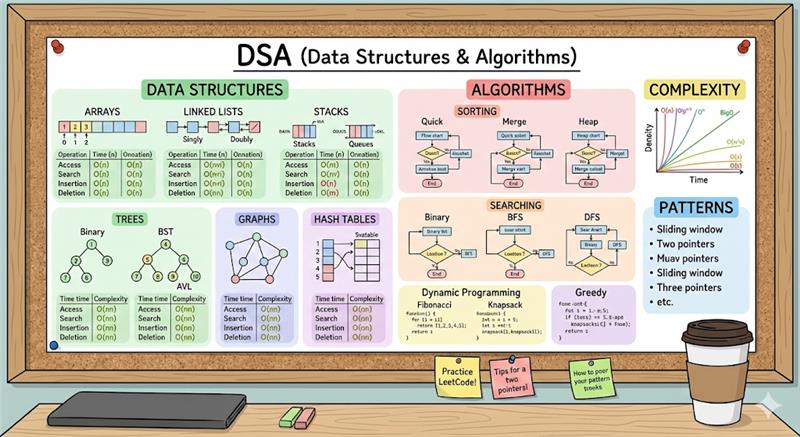
I have compiled the essence of all 11 topics into a single Grand Unified Strategy Document. This is what students should print and stick on their walls 24 hours before their interview. “Students, stop memorizing code. Memorize the Pattern. If you know which tool to use, the code writes itself. Here is the decision matrix … Read more

11) The Complete Bit Manipulation & Math Roadmap: 7 Tricks to Solve “Impossible” Problems (2026 Guide)

” I call this the “Hidden Curriculum.” Most students ignore Bits and Math because they think “I’ll just use a library.” But in a Low-Level System Design interview (at companies like NVIDIA, Qualcomm, Adobe, or High-Frequency Trading firms), knowing how to manipulate bits directly is the difference between an “Average Developer” and a “Hardware-Optimized Engineer.” … Read more

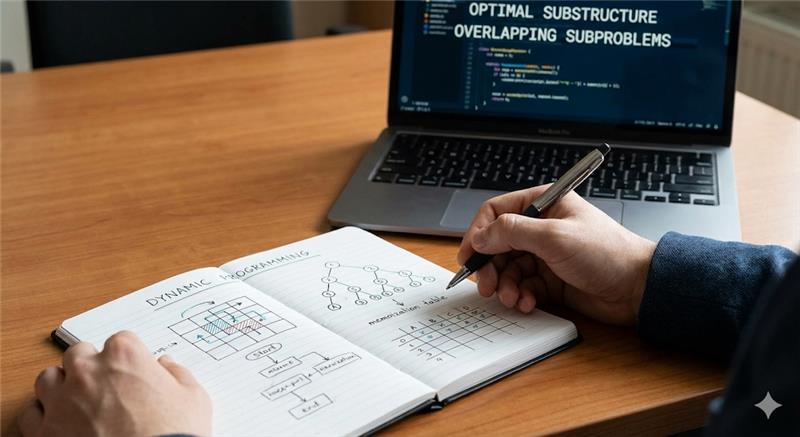
10) The Complete Dynamic Programming Roadmap: 6 Patterns to Solve “Impossible” Problems (2026 Guide)

” I saved this for last because it is the Gateway to FAANG. In an interview, if you solve a Graph problem, you are a “Good Engineer.” If you solve a Hard DP problem, you are a “Top 1% Engineer.” Most students fail DP because they try to memorize solutions. We will teach State Transition … Read more

9)The Complete Recursion & Backtracking Roadmap: 8 Patterns to Master the “Magic” of Coding (2026 Guide)

” I want to emphasize one thing: Recursion is the mother of all algorithms. Trees are just recursion. Graphs are just recursion. Dynamic Programming is just recursion with a notebook. If your students master the “Recursion Tree,” they master half of Computer Science. This guide covers the 8 Core Architectures that turn “Magic” into “Logic.” … Read more

1)The Complete Array Algorithms Roadmap: 12 Patterns from Beginner to Expert (2026 Guide)

Arrays are the “Bread and Butter” of coding. Every interview starts here. But most candidates fail not because they don’t know loop syntax, but because they use Brute Force ($O(N^2)$) instead of Pattern Logic ($O(N)$). To clear top-tier interviews, you must stop thinking about “Loops” and start thinking about “Pointers and Windows.” This guide covers … Read more

2)The Complete String Algorithms Roadmap: 8 Patterns to Crack Any Text Processing Interview (2026 Guide)

“Strings are not just arrays of characters. They are sequences of information.” In the age of LLMs (like ChatGPT) and Bioinformatics (DNA sequencing), String algorithms are the most valuable skill you can possess. If you want to work at Google (Search), Grammarly (Text Processing), or 23andMe (Genetics), you must master these patterns. This guide covers … Read more

3)The Complete Linked List Roadmap: 10 Algorithms from Beginner to Expert (2026 Guide)

“Arrays are for storing data. Linked Lists are for manipulating references.” Arrays are static; Linked Lists are dynamic. If you want to work on Blockchains or Low-Level Memory Management (like inside the Linux Kernel), you must master pointer surgery. This guide covers the 10 Essential Linked List Patterns that separate “Code Monkeys” from “Software Engineers.” … Read more

4)The Complete Stack & Queue Roadmap: 8 Algorithms from Beginner to Expert (2026 Guide)

“Stacks and Queues are the traffic lights of Computer Science.” They control the flow of data. Without them, recursion wouldn’t exist (Call Stack), and the Internet wouldn’t work (Packet Queues). While the operations (push, pop) are trivial, the applications are complex. This guide covers the 8 Essential Patterns that bridge the gap between “Junior Developer” … Read more

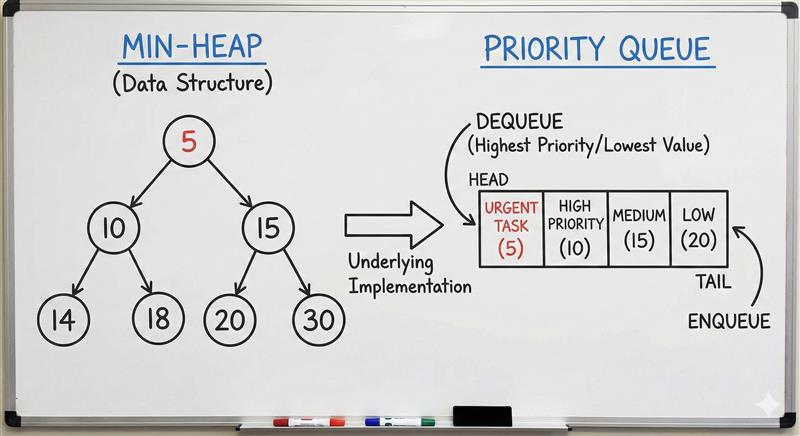
5)The Complete Heap & Priority Queue Roadmap: 7 Algorithms from Beginner to Expert (2026 Guide)

“Sorting takes O(N log N).” We all know that. But what if you don’t need everything sorted? What if you only care about the Top 10 users, or the Next urgent task? Sorting the whole dataset is a waste of resources. This is where the Heap (Priority Queue) shines. It allows us to extract the … Read more

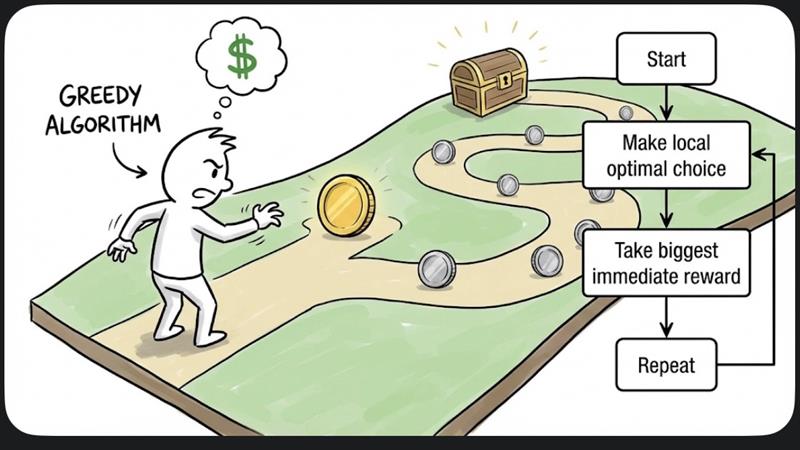
6)The Complete Greedy Algorithms Roadmap: 8 Essential Patterns from Beginner to Expert (2026 Guide)

Greedy Algorithms are the “Smart Shortcuts” of Computer Science. While Dynamic Programming meticulously calculates every possibility ($O(N^2)$), a Greedy Algorithm makes the best local choice at every step ($O(N \log N)$ or $O(N)$) and hopes it leads to the global optimum. For top-tier interviews, you must know when to be greedy and when to stop. … Read more