
” I saved this for last because it is the Gateway to FAANG. In an interview, if you solve a Graph problem, you are a “Good Engineer.” If you solve a Hard DP problem, you are a “Top 1% Engineer.”
Most students fail DP because they try to memorize solutions. We will teach State Transition Patterns. If you know the pattern, the code writes itself.
Welcome to the Grand Finale of our DSA Series.
You have mastered Arrays, Trees, and Recursion. Now, it is time for the “Final Boss”: Dynamic Programming (DP).
DP scares 90% of students. It looks like advanced mathematics.
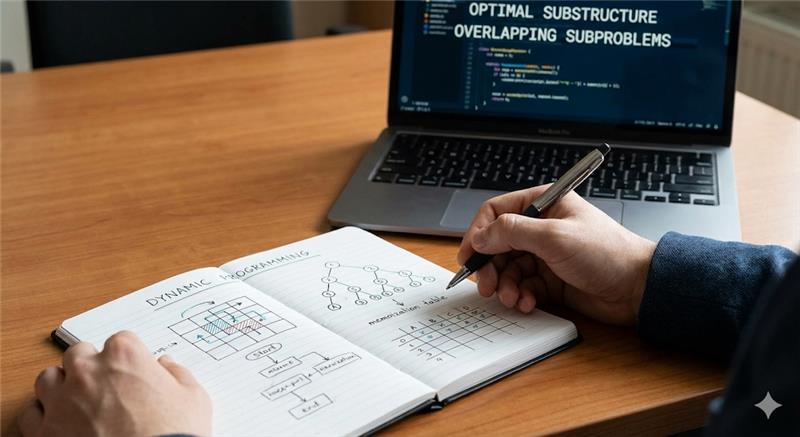
But here is the secret: DP is just Recursion with a Notebook.
When you solve a problem recursively, you often calculate the same thing twice. DP simply says: “Write it down so you don’t have to calculate it again.”
If you are aiming for Google, Uber, or Media.net, you cannot skip this. Here are the 6 Core Patterns that solve 95% of DP questions.
Part 1: The “1D” Patterns (Linear DP)
The answer depends on the immediate past.
1. The Fibonacci Pattern (Climbing Stairs)
- The Scenario: “You can climb 1 or 2 steps. How many ways to reach the top?”
- The Logic: To reach Step 10, you must have come from Step 9 (1 jump) or Step 8 (2 jumps).
ways(n) = ways(n-1) + ways(n-2)
- The “Space Optimization” Trick: You don’t need an array
dp[n]. You only need the last two numbers.- Use variables
prev1,prev2$\to$ Space becomes $O(1)$.
- Use variables
- Trigger: “House Robber,” “Fibonacci Number,” “Domino Tiling.”
2. The LIS Pattern (Longest Increasing Subsequence)
- The Scenario: “Find the longest chain of numbers that are strictly increasing.”
- The Logic: For every number
i, look back at all numbersjbefore it.- If
nums[i] > nums[j], we can extend that chain. dp[i] = max(dp[i], 1 + dp[j])
- If
- Complexity: O(N^2) (Standard) or O(N log N) (Using Binary Search – “Patience Sorting”).
Part 2: The “Grid” Patterns (2D DP)
You are a robot moving on a board.
3. Unique Paths / Min Path Sum
- The Scenario: “How many ways to reach the bottom-right?” or “Find the cheapest path.”
- The Logic: You can only arrive at a cell
(r, c)from Top or Left.dp[r][c] = dp[r-1][c] + dp[r][c-1]
- The Professor’s Note: If there is an obstacle, that path becomes 0.
- Complexity: O(R \times C).
Part 3: The “Knapsack” Patterns (Choice)
The most important pattern for “Optimization” (Max Profit / Min Cost).
4. 0/1 Knapsack (Take it or Leave it)
- The Scenario: You have a bag with capacity
W. Items haveWeightandValue. You cannot break items. - The Logic: At every item, ask: “Is it better to Include this or Exclude this?”
- Option A (Exclude): Inherit value from the previous row (same capacity).
- Option B (Include): Add current item’s value + best value of remaining capacity.
- Formula:
dp[i][w] = max(dp[i-1][w], val[i] + dp[i-1][w - weight[i]]).
- Trigger: “Target Sum,” “Partition Equal Subset Sum.”
5. Unbounded Knapsack (Infinite Supply)
- The Scenario: Same as above, but you can pick the same item multiple times (e.g., Rod Cutting, Coin Change).
- The Difference: When you “Include” an item, you stay at the same index
i(because you can use it again). - Formula:
dp[i] += dp[i - coin_value] - Trigger: “Coin Change II,” “Rod Cutting,” “Ribbon Cutting.”
Part 4: The “String” Patterns (Comparison)
Comparing two texts (Spell Checkers, DNA).
6. Longest Common Subsequence (LCS)
- The Scenario: “How similar are string A and string B?”
- The Logic: Compare characters
A[i]andB[j].- Match?
1 + dp[i-1][j-1](Diagonal + 1). - No Match?
max(dp[i-1][j], dp[i][j-1])(We must skip a character from either A or B. Take the max).
- Match?
- Trigger: “Edit Distance,” “Longest Palindromic Subsequence,” “Delete Operation for Two Strings.”
Part 5: The “Merge” Patterns (Intervals)
Optimizing operations on a sequence.
7. Matrix Chain Multiplication (MCM)
- The Scenario: “Best way to multiply matrices” or “Burst Balloons.”
- The Logic: Where should I place the partition
k?- Try all split points
kfromitoj. Cost = Cost(Left) + Cost(Right) + Cost of Merge.
- Try all split points
- Complexity: O(N^3).
The Professor’s Cheat Code Sheet
Memorize the State Transition Equation. That is 90% of the code.
| Pattern Name | The “Formula” (State Transition) | Time Complexity |
| Fibonacci / Stairs | dp[i] = dp[i-1] + dp[i-2] | O(N) |
| Grid Paths | dp[r][c] = dp[top] + dp[left] | O(R times C) |
| LIS (Increasing) | if nums[i] > nums[j]: dp[i] = max(dp[i], 1+dp[j]) | O(N^2) |
| 0/1 Knapsack | max(Exclude, Val + Include) | O(N times W) |
| Unbounded (Coins) | dp[target] += dp[target - coin] | O(N times T) |
| LCS (Strings) | Match: 1 + diag | No Match: max(up, left) | O(N times M) |
| Edit Distance | Min of (Insert, Delete, Replace) | O(N times M) |
| Palindrome (Gap) | if s[i]==s[j]: 2 + dp[i+1][j-1] | O(N^2) |
Professor’s Advice for Teaching This
“Students, this is the end of the course.
Dynamic Programming is not about code. It is about confidence.
Start with Recursion. If it gives the right answer but is too slow (Time Limit Exceeded), add a Memoization map.
Congratulations, you just solved a Hard DP problem.
You now have the full arsenal: Arrays, Trees, Graphs, and DP. Go crack that interview.”
10) The Complete Dynamic Programming Roadmap: 6 Patterns to Solve “Impossible” Problems (2026 Guide)
Dynamic Programming Patterns Knapsack Problem Explained Longest Common Subsequence Logic ,
Coin Change DP Solution
YouTube Channels:
Trendy VS Vlogs
VS Coding Academy
Join Our WhatsApp Channel for the latest job opportunities and updates:
VS_CODING_ACADEMY WhatsApp Channel
Join Our Telegram Channel for the latest job opportunities and updates: https://t.me/vscodingacademy
Open our site in Telegram Bot: https://t.me/vscodingacademy_bot
For DSA Guide: https://vscodingacademy.com/category/dsa-guide/