
🔮 Master Python Sets with M.A.G.I.C.S.
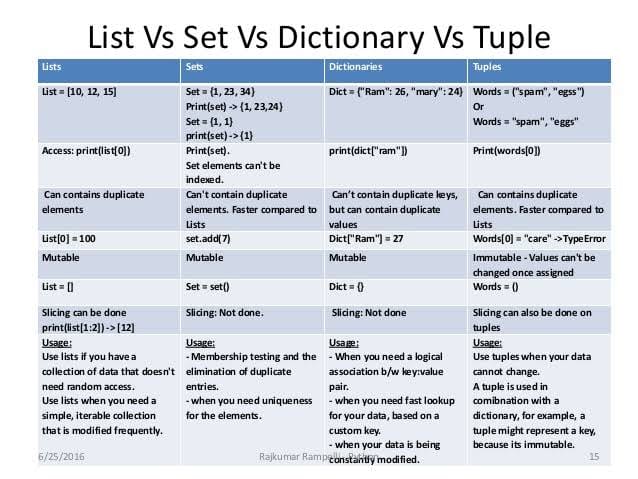
Sets are the “Bouncers” of Python data structures. They are unordered, unindexed, and forbid duplicates. If you try to add the same item twice, the Set will simply ignore it.
Because Sets are unique, the M.A.G.I.C.S. framework has a special “Superpower” section for Math.
The Framework
| Letter | Category | Status | Key Operations |
| M | Make | ✅ Active | {}, set(), {x for x} |
| A | Add | ✅ Active | .add(), .update() |
| G | Get | ⚠️ No Index! | in, for x in s (Cannot use s[0]) |
| I | Improve | ⚠️ Limited | Cannot Sort/Reverse (Unordered). |
| C | Clean | ✅ Active | .remove(), .discard(), .pop() |
| S | Set Math | ✨ Superpower | Union ` |
🟢 1. M – MAKE (Creation)
The biggest trap in Python is trying to create an empty set with {}.
| Operation | Syntax | Example | Result |
| Manual Set | {v1, v2} | s = {1, 2, 3} | {1, 2, 3} |
| Empty (TRAP!) | {} | s = {} | Type: Dict! (Not Set) |
| Empty (Correct) | set() | s = set() | set() |
| From List | set(list) | s = set([1, 2, 2]) | {1, 2} (Auto-removes duplicates) |
| Comprehension | {x for x..} | s = {x for x in "aba"} | {'a', 'b'} |
🔵 2. A – ADD (Growth)
Since Sets have no order, you don’t “append” (add to end); you simply “add”.
| Operation | Syntax | Example | Result |
| Add One | .add(x) | s.add(5) | Adds 5 (if not present) |
| Add Many | .update(iter) | s.update([6, 7]) | Adds 6 and 7 |
| Insert? | ❌ | s.insert(0, 1) | AttributeError (No Index) |
🟡 3. G – GET (Access & Find)
You cannot ask for “Item #1”. You can only ask “Are you here?”
| Operation | Syntax | Example | Result |
| Check (Fast) | x in s | 5 in s | True / False |
| Iterate | for x in s | for x in s: print(x) | Prints items (Random order!) |
| Index Access? | ❌ | s[0] | TypeError (Not subscriptable) |
🟠 4. I – IMPROVE (Modify)
You cannot change an item (s[0] = 5) because items have no fixed spot.
| Operation | Syntax | Example | Result |
| Update Item? | ❌ | s[0] = 9 | TypeError |
| Sort? | ❌ | s.sort() | AttributeError (No order) |
| Sort New | sorted(s) | L = sorted(s) | Returns a sorted List [...]. |
🔴 5. C – CLEAN (Deletion)
Sets have a special method .discard() that is safer than .remove().
| Operation | Syntax | Example | Result |
| Remove (Strict) | .remove(x) | s.remove(5) | Removes 5 (Crashes if missing) |
| Discard (Safe) | .discard(x) | s.discard(5) | Removes 5 (Does nothing if missing) |
| Pop (Random) | .pop() | v = s.pop() | Removes & returns a random item. |
| Clear | .clear() | s.clear() | Empties set. |
🟣 6. S – SET MATH (The Superpower)
This is the main reason developers use Sets: Set Theory.
| Operation | Math Name | Syntax | Example | What it does |
| Union | OR (` | `) | `s1 | s2` |
| Intersection | AND (&) | s1 & s2 | {1,2} & {2,3} | Keeps only items in BOTH. (Result {2}) |
| Difference | MINUS (-) | s1 - s2 | {1,2} - {2} | Keeps items in s1 NOT in s2. (Result {1}) |
| Symmetric | XOR (^) | s1 ^ s2 | {1,2} ^ {2,3} | Keeps unique items. Removes common ones. {1, 3} |
⭐ PRO TIPS (Why use Sets?)
Sets are faster than lists for specific tasks.
| Feature | Code Example | Why use it? |
| Instant Deduplication | L = list(set(my_list)) | The fastest way to remove duplicates from a list. |
| Super Speed Lookup | if x in my_set: | Checking in a Set is O(1) (Instant). Checking a List is O(n) (Slow). |
| Common Items | s1.intersection(s2) | Easily find matches between two datasets (e.g., Common followers). |
| Frozen Set | frozenset([1, 2]) | A “Locked” set. Immutable (like a Tuple) and can be a Dict Key. |
🆚 Quick Interview Comparison
| Feature | Python List [] | Python Set {} |
| Order | ✅ Ordered (0, 1, 2…) | ❌ Unordered (Random) |
| Duplicates | ✅ Allowed | ❌ Forbidden |
| Lookup Speed | 🐢 Slow O(n) | ⚡ Fast O(1) |
| Syntax | [1, 2] | {1, 2} |
Master Python Sets in 10 Minutes: The Ultimate M.A.G.I.C.S. Cheat Sheet
YouTube Channels:
Trendy VS Vlogs
VS Coding Academy
Join Our WhatsApp Channel for the latest job opportunities and updates:
VS_CODING_ACADEMY WhatsApp Channel
Join Our Telegram Channel for the latest job opportunities and updates: https://t.me/vscodingacademy
Open our site in Telegram Bot: https://t.me/vscodingacademy_bot
For DSA Guide: https://vscodingacademy.com/category/dsa-guide/