
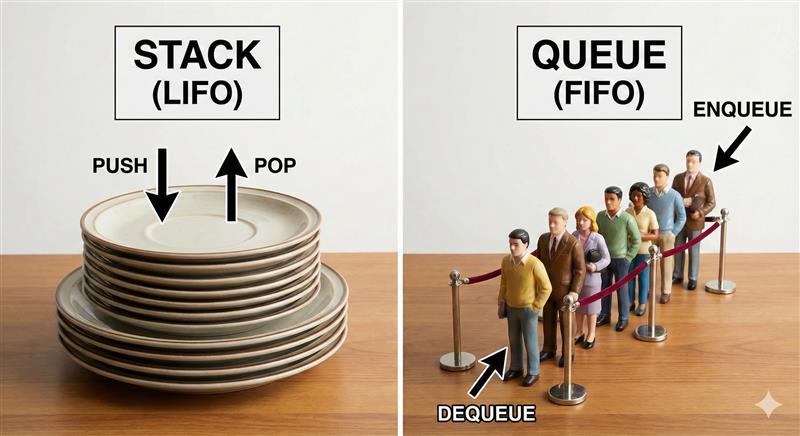
“Stacks and Queues are the traffic lights of Computer Science.” They control the flow of data. Without them, recursion wouldn’t exist (Call Stack), and the Internet wouldn’t work (Packet Queues).
While the operations (push, pop) are trivial, the applications are complex. This guide covers the 8 Essential Patterns that bridge the gap between “Junior Developer” and “System Architect.”
Stacks (LIFO) and Queues (FIFO) seem simple. You push, you pop. What’s the big deal?
The big deal is Order Management.
- Stack reverses order (like a browser back button).
- Queue preserves order (like a printer line).
- Deque (Double-Ended Queue) allows flexibility on both ends.
Top companies like Amazon and Adobe use these questions to filter candidates who understand data flow versus those who just memorize syntax. Here are the 8 Core Patterns you must master.
Part 1: The “Matching” Pattern (Nested Structures)
Stacks are perfect for “Unfinished Business”—things you opened but haven’t closed yet.
1. Valid Parentheses
- The Scenario: Check if
({[]})is valid. - The Logic:
- See an Opener
(,{? Push to Stack. - See a Closer
),}? Pop and check if it matches the Opener. - If Stack is empty at the end Valid.
- See an Opener
- Professor’s Insight: This is the core logic for Compilers (checking syntax errors).
2. Simplify Path (File System)
- The Scenario: Convert
/a/./b/../../c/to/c. - The Logic:
- Split string by
/. ..means “Go Back” Pop from Stack..means “Stay” Do nothing.- Name means “Go Down” Push to Stack.
- Split string by
Part 2: The “Monotonic” Pattern (The Interview Favorite)
This is the #1 hardest topic for beginners. We maintain a Stack/Queue that is ALWAYS sorted.
3. Next Greater Element (Monotonic Stack)
- The Question: “For every number, find the next bigger number on its right.”
- The Logic:
- Traverse the array.
- While
Current_Num > Stack_Top:- The
Stack_Topjust found its “Next Greater” (it’s the Current Num!). - Pop the small guy.
- The
- Push Current Num.
- Complexity: O(N) (Every element is pushed/popped exactly once).
4. Sliding Window Maximum (Monotonic Deque)
- The Question: “Find the max value in every window of size K.”
- The Logic: You need a Queue that supports
pop_front(when window slides) andpop_back(to maintain order).- Remove indices that are out of the current window (front).
- Remove numbers that are smaller than the current number (back) because they will never be the “Max” again.
- Push current index. The Front is always the Max.
Part 3: The “Design” Pattern (Architecture)
Can you build a data structure with specific constraints?
5. Min-Stack (O(1) Retrieval)
- The Question: “Design a Stack that supports
push,pop, andgetMinall in O(1).” - The Logic: You cannot scan the stack for the minimum.
- Use Two Stacks.
- Main Stack: Stores actual data.
- Min Stack: Stores the “Minimum seen so far.”
- When popping, if the value matches the top of Min Stack, pop it too.
6. LRU Cache (The “Google” Question)
- The Scenario: “Design a cache that forgets the least recently used item.”
- The Logic: This combines a Doubly Linked List (for order) and a Hash Map (for O(1) lookup).
- Most recently used item moves to the Front.
- If full, delete from the Tail.
Part 4: The “Breadth” Pattern (Processing Layers)
Using Queues to process things layer-by-layer.
7. Rotting Oranges / Shortest Path in Grid
- The Question: “How many minutes until all oranges rot?” or “Shortest path in a maze.”
- The Logic: This is Multi-Source BFS.
- Push all initially rotten oranges into the Queue.
- Process level by level (minute by minute).
- Infect neighbors and push them to Queue.
8. Circular Queue (Ring Buffer)
- The Scenario: “Implement a Queue using a fixed-size array.”
- The Logic: Use modulo arithmetic
%to wrap around.Next_Pos = (Current_Pos + 1) % Size.- Crucial for low-level system design (CPU buffers).
The Professor’s Cheat Code Sheet
Stick this table at the bottom of your post. It tells students exactly which tool to pick.
| Problem Signal | The Data Structure | The Algorithm Strategy |
| Nested Brackets / Tags | Stack | Push Openers, Match Closers |
| “Next Greater/Smaller” | Monotonic Stack | Pop smaller elements before pushing |
| “Undo” Button / History | Stack | LIFO (Last In First Out) |
| Window Max / Min | Monotonic Deque | Remove useless elements from back |
| Level-by-Level / Layers | Queue | BFS (Breadth First Search) |
| Shortest Path (Grid) | Queue | BFS |
| O(1) Min/Max Query | Auxiliary Stack | Keep a parallel “Min” stack |
| Cache / Recent Items | Doubly Linked List + Map | LRU Strategy |
Professor’s Advice for Teaching This
“Students, here is the secret:
- Stack = Vertical Thinking. Use it when you need to dig deep or look back (Undo, Recursion, Parsing).
- Queue = Horizontal Thinking. Use it when you want fairness or layers (Printers, BFS, Buffers).
- Monotonic Stack is the ‘boss level.’ If you master that
whileloop, you are in the top 10% of candidates.”
The Complete Stack & Queue Roadmap: 8 Algorithms from Beginner to Expert (2026 Guide)
Stack Data Structure Interview Monotonic Stack Explained Next Greater Element Solution Sliding Window Maximum Deque
YouTube Channels:
Trendy VS Vlogs
VS Coding Academy
Join Our WhatsApp Channel for the latest job opportunities and updates:
VS_CODING_ACADEMY WhatsApp Channel
Join Our Telegram Channel for the latest job opportunities and updates: https://t.me/vscodingacademy
Open our site in Telegram Bot: https://t.me/vscodingacademy_bot
For DSA Guide: https://vscodingacademy.com/category/dsa-guide/