
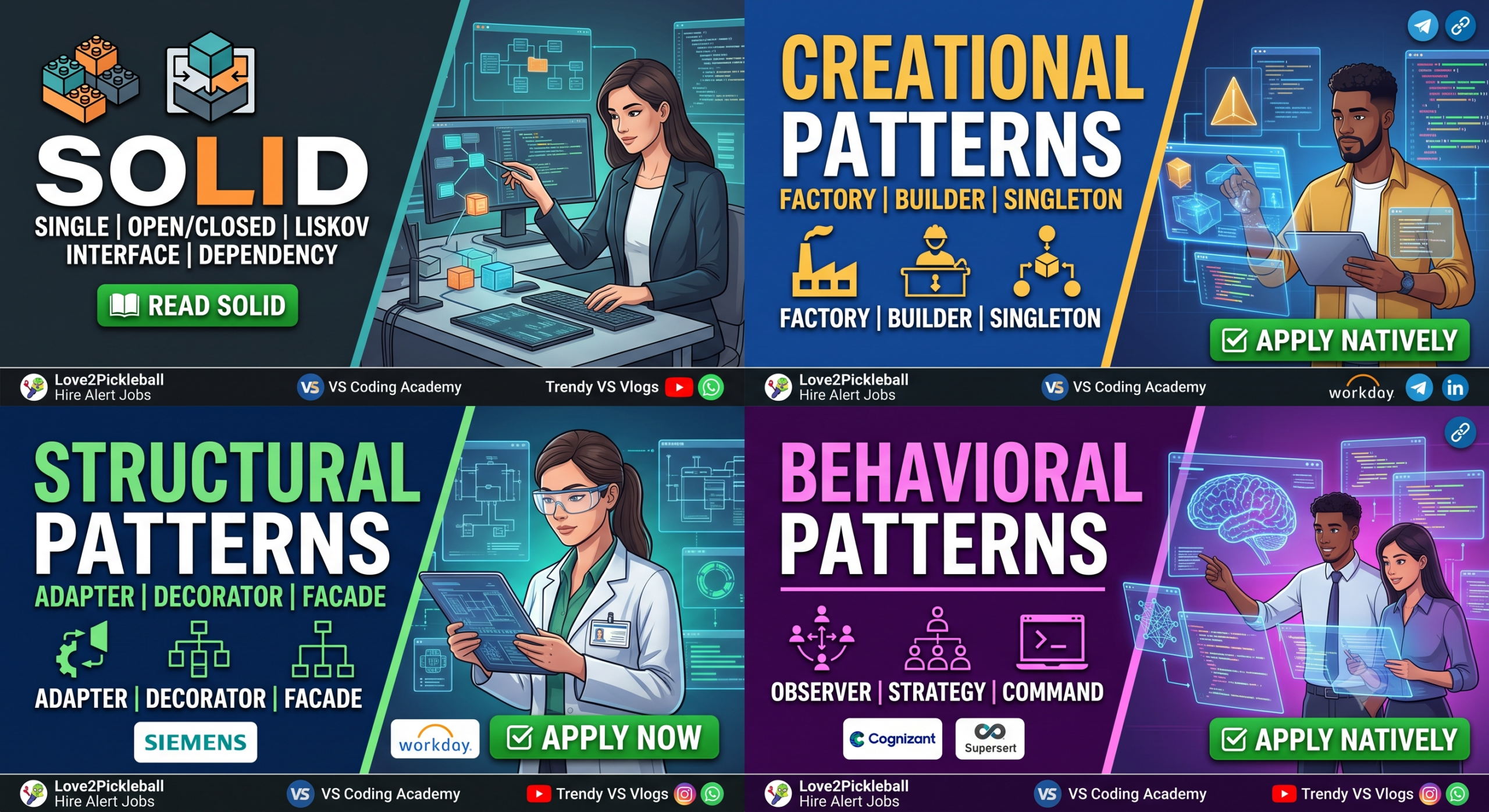
In the realm of software engineering, object creation is often the silent killer of system maintainability and scalability. When concrete classes are instantiated haphazardly throughout a codebase, tight coupling ensues, rendering testing, extending, and refactoring incredibly difficult. This comprehensive architectural guide explores the five foundational creational design patterns—Singleton, Factory Method, Abstract Factory, Builder, and Prototype—demystifying their implementation in both high-performance C++ and highly dynamic Python. By mastering these patterns, you will elevate your system design capability, write cleaner production-grade code, and confidently ace low-level design (LLD) interviews at top-tier technology firms. ===
Mastering Creational Design Patterns in C++ and Python: The Definitive Architectural Guide
Architectural Introduction & Patterns Overview
Creational design patterns constitute a fundamental category of software design blueprints that abstract the instantiation process, decoupling a system from how its objects are created, composed, and represented. In modern backend engineering, these patterns serve as the bedrock for constructing scalable, resilient, and highly maintainable microservices and enterprise systems by mitigating the architectural risks of tight coupling. By encapsulating concrete class knowledge behind well-defined abstract interfaces, creational patterns allow systems to evolve independently of specific implementations. Consequently, demonstrating deep proficiency in these patterns is a critical evaluation vector during senior and principal engineering interviews, where candidates must prove they can design systems that are both flexible under changing requirements and robust under heavy production loads.
Demystifying Creational Patterns in Modern Software
In complex enterprise architectures, direct instantiation of objects using the raw new operator or direct constructor calls introduces severe architectural rigidity. This tight coupling binds the calling code to specific concrete implementations, making it incredibly difficult to swap out components for testing or to support new business requirements. Creational design patterns elegantly resolve this issue by shifting the responsibility of object creation from the client code to specialized creational entities, establishing a clean separation of concerns.
As software development has evolved, modern languages like C++ and Python have introduced sophisticated memory management and runtime capabilities that change how we implement these classic patterns. In C++, features like smart pointers (std::unique_ptr and std::shared_ptr) and Move Semantics ensure that creational patterns do not incur unnecessary memory overhead or resource leaks. Meanwhile, Python leverages its dynamic typing, decorators, and metaclasses to provide elegant, low-boilerplate implementations of these exact same structural concepts.
Beyond mere code aesthetics, the strategic application of creational patterns directly impacts system performance, resource utilization, and overall system design. In high-throughput environments, optimizing how and when objects are allocated can prevent memory fragmentation, minimize database connection overhead, and streamline thread utilization. Therefore, understanding the delicate balance between C++’s compile-time optimization guarantees and Python’s runtime flexibility is essential for any modern software architect aiming to build high-performance systems. Check out our latest career opportunities and industry insights at the Hire Alert Jobs category.
Deep Dive into the Five Core Creational Patterns
To build a robust low-level design foundation, we must thoroughly examine the five core creational design patterns defined by the Gang of Four (GoF): Singleton, Factory Method, Abstract Factory, Builder, and Prototype. Each of these patterns addresses a specific creational pain point, ranging from enforcing a single point of global access to dynamically cloning runtime configurations. By categorizing and comparing these patterns, developers can easily identify which tool is best suited for their specific architectural challenges.
These five patterns can be broadly split into class-creational patterns, which utilize inheritance to defer instantiation decisions to subclasses, and object-creational patterns, which delegate creation responsibilities to other objects via composition. For example, the Factory Method relies on class inheritance to let subclasses decide which class to instantiate, whereas the Abstract Factory, Builder, and Prototype rely on object composition to assemble complex configurations. Understanding this structural distinction is key to selecting the right level of abstraction for your system.
Furthermore, these patterns do not exist in isolation; they are highly complementary and frequently used in combination within production-grade systems. A Builder pattern might utilize an Abstract Factory to instantiate specific sub-components, while a Singleton might manage the lifecycle of that very factory. By mastering the individual mechanics and the collaborative potential of these patterns, engineers can design cohesive, self-assembling system architectures that scale effortlessly as business domains expand.
Implementing Creational Patterns in C++ and Python
Implementing creational patterns across C++ and Python offers an illuminating study in contrasting language philosophies, pitting compile-time safety against runtime dynamism. In C++, we must prioritize strict type safety, resource acquisition is initialization (RAII), and explicit lifetime management to prevent memory leaks and undefined behavior in multi-threaded environments. Conversely, Python’s philosophy encourages rapid development, duck typing, and built-in language constructs that often simplify or completely reimagine classic GoF boilerplate code.
To ensure these implementations are production-ready, our code examples will avoid trivial toy structures and instead focus on thread-safe, exception-safe, and highly modular architectures. We will employ C++17/C++20 standards, utilizing smart pointers to enforce clean ownership semantics, alongside modern Python 3 idioms such as ABCs (Abstract Base Classes), type hinting, and custom metaclasses. This side-by-side comparison highlights how the exact same architectural intent translates across different execution environments.
Let us now dive into the exhaustive, structured technical analysis of each pattern. For each of the five patterns, we will explore its historical origin, analyze its real-world production use cases, and provide fully functional, production-grade code implementations in both modern C++ and Python.
Comprehensive Patterns Deep-Dive Breakdown
1. Singleton Pattern
History & Origin
The Singleton pattern was formalized by the Gang of Four to solve the problem of coordinating global state and resources without resorting to unsafe global variables. Historically, developers struggled with race conditions and undefined initialization order of global objects across translation units. The Singleton provides a controlled, single point of access to a unique instance, deferring initialization until the instance is first requested.
Real-World Industry Use Cases
- Database Connection Pools: Managing a fixed set of database connections across an entire application backend to prevent resource exhaustion.
- Configuration Managers: A centralized, read-only cache of application settings loaded from a YAML or JSON file at startup.
- Logging Engines: A thread-safe logger writing to a single log file, ensuring synchronous access to the file system.
Production C++ Code Implementation
#include
#include
#include
#include

class DatabaseConnectionPool {
private:
    // Private constructor to prevent instantiation
    DatabaseConnectionPool() {
        std::cout << "Database Connection Pool Initialized.n";
    }

    // Prevent copying and assignment
    DatabaseConnectionPool(const DatabaseConnectionPool&) = delete;
    DatabaseConnectionPool& operator=(const DatabaseConnectionPool&) = delete;

public:
    // Thread-safe Meyers Singleton (C++11 guaranteed)
    static DatabaseConnectionPool& getInstance() {
        static DatabaseConnectionPool instance;
        return instance;
    }

    void executeQuery(const std::string& query) {
        std::cout << "Executing query: " << query << " on thread-safe connection pool.n";
    }
};

int main() {
    DatabaseConnectionPool& pool = DatabaseConnectionPool::getInstance();
    pool.executeQuery("SELECT * FROM users;");
    return 0;
}
Production Python Code Implementation
import threading

class SingletonMeta(type):
    """
    A thread-safe implementation of Singleton using metaclasses.
    """
    _instances = {}
    _lock: threading.Lock = threading.Lock()

    def __call__(cls, *args, **kwargs):
        with cls._lock:
            if cls not in cls._instances:
                instance = super().__call__(*args, **kwargs)
                cls._instances[cls] = instance
        return cls._instances[cls]

class DatabaseConnectionPool(metaclass=SingletonMeta):
    def __init__(self):
        print("Database Connection Pool Initialized.")

    def execute_query(self, query: str):
        print(f"Executing query: {query} on thread-safe connection pool.")

if __name__ == "__main__":
    pool1 = DatabaseConnectionPool()
    pool2 = DatabaseConnectionPool()

    assert pool1 is pool2
    pool1.execute_query("SELECT * FROM products;")
2. Factory Method Pattern
History & Origin
The Factory Method arose from the need to decouple the creator of an object from the actual concrete product being created. In early framework designs, developers needed to write code that manipulated abstract products, but the framework itself could not know which concrete classes the client application would instantiate. The Factory Method solves this by defining an interface for creating an object, but letting subclasses decide which class to instantiate.
Real-World Industry Use Cases
- UI Element Rendering: A framework rendering buttons or dialogs where a
WindowsDialogcreates aWindowsButtonand aMacDialogcreates aMacButton. - Document Parsers: An application that opens different file formats (PDF, CSV, JSON) and instantiates the corresponding parser class dynamically.
- Payment Gateways: Instantiating Stripe, PayPal, or Adyen payment processors based on user checkout preferences.
Production C++ Code Implementation
#include
#include
#include

// Product Interface
class PaymentProcessor {
public:
    virtual ~PaymentProcessor() = default;
    virtual void processPayment(double amount) = 0;
};

// Concrete Product A
class StripeProcessor : public PaymentProcessor {
public:
    void processPayment(double amount) override {
        std::cout << "Processing $" << amount << " via Stripe.n";
    }
};

// Concrete Product B
class PayPalProcessor : public PaymentProcessor {
public:
    void processPayment(double amount) override {
        std::cout << "Processing $" << amount << " via PayPal.n";
    }
};

// Creator (Factory) Interface
class PaymentGateway {
public:
    virtual ~PaymentGateway() = default;
    virtual std::unique_ptr createProcessor() = 0;

    void executeTransaction(double amount) {
        auto processor = createProcessor();
        processor->processPayment(amount);
    }
};

// Concrete Creator A
class StripeGateway : public PaymentGateway {
public:
    std::unique_ptr createProcessor() override {
        return std::make_unique();
    }
};

// Concrete Creator B
class PayPalGateway : public PaymentGateway {
public:
    std::unique_ptr createProcessor() override {
        return std::make_unique();
    }
};

int main() {
    std::unique_ptr gateway = std::make_unique();
    gateway->executeTransaction(150.00);
    return 0;
}
Production Python Code Implementation
from abc import ABC, abstractmethod

# Product Interface
class PaymentProcessor(ABC):
    @abstractmethod
    def process_payment(self, amount: float) -> None:
        pass

# Concrete Product A
class StripeProcessor(PaymentProcessor):
    def process_payment(self, amount: float) -> None:
        print(f"Processing ${amount} via Stripe.")

# Concrete Product B
class PayPalProcessor(PaymentProcessor):
    def process_payment(self, amount: float) -> None:
        print(f"Processing ${amount} via PayPal.")

# Creator Interface
class PaymentGateway(ABC):
    @abstractmethod
    def create_processor(self) -> PaymentProcessor:
        pass

    def execute_transaction(self, amount: float) -> None:
        processor = self.create_processor()
        processor.process_payment(amount)

# Concrete Creator A
class StripeGateway(PaymentGateway):
    def create_processor(self) -> PaymentProcessor:
        return StripeProcessor()

# Concrete Creator B
class PayPalGateway(PaymentGateway):
    def create_processor(self) -> PaymentProcessor:
        return PayPalProcessor()

if __name__ == "__main__":
    gateway = StripeGateway()
    gateway.execute_transaction(250.50)
3. Abstract Factory Pattern
History & Origin
The Abstract Factory pattern was developed to provide an interface for creating families of related or dependent objects without specifying their concrete classes. In complex GUI systems, keeping consistent look-and-feel themes (such as Dark Mode vs. Light Mode) across multiple UI elements (buttons, scrollbars, text fields) was historically error-prone. The Abstract Factory group-instantiates compatible components, preventing developer errors where mismatched themes are mixed.
Real-World Industry Use Cases
- Cross-Platform Operating System APIs: Creating compatible filesystem, network, and windowing elements for Windows, macOS, and Linux.
- Cloud Infrastructure Provisioning: Spinning up VM instances, storage buckets, and virtual networks specific to AWS, Azure, or GCP.
- Game Development Asset Packs: Generating level-appropriate assets (e.g., Medieval vs. Sci-Fi weapons, armor, and environments).
Production C++ Code Implementation
#include
#include
#include

// Abstract Products
class Button {
public:
    virtual ~Button() = default;
    virtual void paint() = 0;
};

class ScrollBar {
public:
    virtual ~ScrollBar() = default;
    virtual void scroll() = 0;
};

// Concrete Products (Dark Theme)
class DarkButton : public Button {
public:
    void paint() override { std::cout << "Rendering Dark Button.n"; }
};

class DarkScrollBar : public ScrollBar {
public:
    void scroll() override { std::cout << "Scrolling Dark ScrollBar.n"; }
};

// Concrete Products (Light Theme)
class LightButton : public Button {
public:
    void paint() override { std::cout << "Rendering Light Button.n"; }
};

class LightScrollBar : public ScrollBar {
public:
    void scroll() override { std::cout << "Scrolling Light ScrollBar.n"; }
};

// Abstract Factory
class GUIFactory {
public:
    virtual ~GUIFactory() = default;
    virtual std::unique_ptr createButton() = 0;
    virtual std::unique_ptr createScrollBar() = 0;
};

// Concrete Factories
class DarkThemeFactory : public GUIFactory {
public:
    std::unique_ptr createButton() override { return std::make_unique(); }
    std::unique_ptr createScrollBar() override { return std::make_unique(); }
};

class LightThemeFactory : public GUIFactory {
public:
    std::unique_ptr createButton() override { return std::make_unique(); }
    std::unique_ptr createScrollBar() override { return std::make_unique(); }
};

int main() {
    std::unique_ptr factory = std::make_unique();
    auto btn = factory->createButton();
    auto sb = factory->createScrollBar();
    btn->paint();
    sb->scroll();
    return 0;
}
Production Python Code Implementation
from abc import ABC, abstractmethod

# Abstract Products
class Button(ABC):
    @abstractmethod
    def paint(self) -> None:
        pass

class ScrollBar(ABC):
    @abstractmethod
    def scroll(self) -> None:
        pass

# Concrete Products (Dark Theme)
class DarkButton(Button):
    def paint(self) -> None:
        print("Rendering Dark Button.")

class DarkScrollBar(ScrollBar):
    def scroll(self) -> None:
        print("Scrolling Dark ScrollBar.")

# Abstract Factory
class GUIFactory(ABC):
    @abstractmethod
    def create_button(self) -> Button:
        pass

    @abstractmethod
    def create_scrollbar(self) -> ScrollBar:
        pass

# Concrete Factory (Dark Theme)
class DarkThemeFactory(GUIFactory):
    def create_button(self) -> Button:
        return DarkButton()

    def create_scrollbar(self) -> ScrollBar:
        return DarkScrollBar()

if __name__ == "__main__":
    factory: GUIFactory = DarkThemeFactory()
    btn = factory.create_button()
    sb = factory.create_scrollbar()
    btn.paint()
    sb.scroll()
4. Builder Pattern
History & Origin
The Builder pattern was introduced to solve the “Telescoping Constructor” anti-pattern, where a class has an overwhelming number of constructors to accommodate various combinations of optional parameters. It separates the construction of a complex object from its representation. This allows the same construction process to create different representations step-by-step.
Real-World Industry Use Cases
- SQL Query Generation: Step-by-step assembly of complex SQL statements containing multiple
SELECT,WHERE,JOIN, andLIMITclauses. - HTTP Request Builders: Constructing API requests with customizable headers, query parameters, authentication tokens, and payload bodies.
- Document Generation: Building structural reports with variable headers, tables, footers, and visual styles.
Production C++ Code Implementation
#include
#include
#include
#include

class Pizza {
public:
    std::string dough;
    std::string sauce;
    std::vector toppings;

    void showPizza() const {
        std::cout << "Pizza with " << dough << " dough, " << sauce << " sauce, and toppings: ";
        for (const auto& topping : toppings) {
            std::cout << topping << " ";
        }
        std::cout << "n";
    }
};

class PizzaBuilder {
protected:
    std::unique_ptr pizza;
public:
    PizzaBuilder() { reset(); }
    virtual ~PizzaBuilder() = default;

    void reset() {
        pizza = std::make_unique();
    }

    std::unique_ptr getPizza() {
        std::unique_ptr result = std::move(pizza);
        reset();
        return result;
    }

    virtual PizzaBuilder& buildDough() = 0;
    virtual PizzaBuilder& buildSauce() = 0;
    virtual PizzaBuilder& buildToppings() = 0;
};

class HawaiianPizzaBuilder : public PizzaBuilder {
public:
    PizzaBuilder& buildDough() override {
        pizza->dough = "cross";
        return *this;
    }
    PizzaBuilder& buildSauce() override {
        pizza->sauce = "mild";
        return *this;
    }
    PizzaBuilder& buildToppings() override {
        pizza->toppings.push_back("ham");
        pizza->toppings.push_back("pineapple");
        return *this;
    }
};

class Director {
public:
    std::unique_ptr makePizza(PizzaBuilder& builder) {
        builder.buildDough().buildSauce().buildToppings();
        return builder.getPizza();
    }
};

int main() {
    Director director;
    HawaiianPizzaBuilder builder;
    auto pizza = director.makePizza(builder);
    pizza->showPizza();
    return 0;
}
Production Python Code Implementation
from typing import List

class Pizza:
    def __init__(self):
        self.dough: str = ""
        self.sauce: str = ""
        self.toppings: List[str] = []

    def __str__(self) -> str:
        return f"Pizza with {self.dough} dough, {self.sauce} sauce, and toppings: {', '.join(self.toppings)}"

class PizzaBuilder:
    def __init__(self):
        self.pizza = Pizza()

    def reset(self) -> None:
        self.pizza = Pizza()

    def build_dough(self) -> 'PizzaBuilder':
        pass

    def build_sauce(self) -> 'PizzaBuilder':
        pass

    def build_toppings(self) -> 'PizzaBuilder':
        pass

    def get_pizza(self) -> Pizza:
        product = self.pizza
        self.reset()
        return product

class HawaiianPizzaBuilder(PizzaBuilder):
    def build_dough(self) -> 'HawaiianPizzaBuilder':
        self.pizza.dough = "cross"
        return self

    def build_sauce(self) -> 'HawaiianPizzaBuilder':
        self.pizza.sauce = "mild"
        return self

    def build_toppings(self) -> 'HawaiianPizzaBuilder':
        self.pizza.toppings.extend(["ham", "pineapple"])
        return self

class Director:
    def make_pizza(self, builder: PizzaBuilder) -> Pizza:
        builder.build_dough().build_sauce().build_toppings()
        return builder.get_pizza()

if __name__ == "__main__":
    director = Director()
    builder = HawaiianPizzaBuilder()
    pizza = director.make_pizza(builder)
    print(pizza)
5. Prototype Pattern
History & Origin
The Prototype pattern was formalized to avoid the high overhead of creating new objects from scratch when similar objects already exist in memory. Direct instantiation can involve expensive database queries, heavy disk operations, or complex computation. By specifying the kinds of objects to create using a prototypical instance, and creating new objects by copying this prototype, performance is drastically improved.
Real-World Industry Use Cases
- Game Entity Spawning: Cloning hundreds of identical monster or particle entities in a game loop to avoid real-time instantiation lag.
- Data Cache Initialization: Copying static database templates or baseline network packets instead of querying servers repeatedly.
- CAD/Graphic Editors: Allowing users to duplicate complex drawn elements (e.g., custom 3D shapes) instantaneously.
Production C++ Code Implementation
#include
#include
#include

// Prototype Interface
class Monster {
public:
    virtual ~Monster() = default;
    virtual std::unique_ptr clone() const = 0;
    virtual void printDetails() const = 0;
    virtual void setHealth(int hp) = 0;
};

// Concrete Prototype
class Zombie : public Monster {
private:
    std::string type;
    int health;
public:
    Zombie(std::string t, int hp) : type(t), health(hp) {}

    std::unique_ptr clone() const override {
        return std::make_unique(*this); // Deep copy
    }

    void printDetails() const override {
        std::cout << "Zombie Type: " << type << " | Health: " << health << "n";
    }

    void setHealth(int hp) override {
        health = hp;
    }
};

int main() {
    std::unique_ptr prototypeZombie = std::make_unique("Runner", 100);

    // Clone the prototype and modify state
    auto zombie1 = prototypeZombie->clone();
    zombie1->setHealth(80);

    prototypeZombie->printDetails();
    zombie1->printDetails();
    return 0;
}
Production Python Code Implementation
import copy
from abc import ABC, abstractmethod

# Prototype Interface
class Monster(ABC):
    @abstractmethod
    def clone(self) -> 'Monster':
        pass

    @abstractmethod
    def print_details(self) -> None:
        pass

# Concrete Prototype
class Zombie(Monster):
    def __init__(self, zombie_type: str, health: int):
        self.zombie_type = zombie_type
        self.health = health

    def clone(self) -> 'Zombie':
        # Utilizing Python's copy module for deep copying
        return copy.deepcopy(self)

    def print_details(self) -> None:
        print(f"Zombie Type: {self.zombie_type} | Health: {self.health}")

if __name__ == "__main__":
    prototype_zombie = Zombie("Runner", 100)

    # Clone and modify
    zombie1 = prototype_zombie.clone()
    zombie1.health = 80

    prototype_zombie.print_details()
    zombie1.print_details()
System Design Roadmap and Educational Resources
Translating object-oriented patterns into distributed systems requires understanding how local design choices scale across networks. For instance, while a Singleton ensures a single instance within a single JVM or process, microservices architectures require distributed coordination mechanisms (such as Redis or ZooKeeper) to enforce global uniqueness across multiple instances. Developing this high-level perspective bridges the gap between low-level design and scalable cloud infrastructure.
Continuous practice and access to curated educational resources are essential for mastering these complex architectural strategies. Leveraging online guides, design patterns masterclasses, and interactive coding sessions helps cement these concepts, moving beyond theory into practical, hands-on application. By actively studying patterns, you train your brain to recognize structural problems and apply standardized, industry-proven solutions instinctively.
Whether you are refactoring a legacy enterprise application or preparing for an intense system design interview, mastering creational patterns in C++ and Python will significantly enhance your software engineering capability. We highly encourage you to utilize the resources listed below to further structure your learning journey and prepare yourself for elite engineering roles in the technology sector.
Before analyzing raw code blocks and practicing object-oriented structures, watch this masterclass design pattern video guide:
https://youtu.be/XDIysqu7S5o
Follow our YouTube Channels for Coding Concepts & Architecture:
- VS Coding Academy: https://youtube.com/@vscodingacademy?si=NMiIIek8BVn7K0ii
- Trendy VS Vlogs: https://youtube.com/@trendyvsvlogs?si=NMiIIek8BVn7K0ii
Join Our Technical Communities for Daily Study Guides & Alerts:
- WhatsApp Channel: https://whatsapp.com/channel/0029Vb9H4vC545v2HaoKk735
- Telegram Channel: https://t.me/vscodingacademy
Deep-Dive DSA & Coding Reference Guide:
- Master Data Structures & Algorithms: https://vscodingacademy.com/category/dsa-guide/
Mastering Creational Design Patterns in C++ and Python: The Definitive Architectural Guide
Effectively managing object creation is the first step toward building modular, scalable, and highly testable applications. By implementing the Singleton, Factory Method, Abstract Factory, Builder, and Prototype patterns in C++ and Python, you equip yourself with the tools needed to tackle complex architectural challenges with ease. Keep exploring these design principles, practice refactoring real-world codebases, and stay connected with our community to ensure you remain at the cutting edge of low-level and high-level system design. ===
Keywords: Creational Design Patterns, C++ Design Patterns, Python Design Patterns, Low Level Design
Tags: Singleton Pattern, Factory Method Pattern, Abstract Factory Pattern, Builder Pattern, Prototype Pattern, C++ Source Code, Python Implementations, Low Level Design, VS Coding Academy, Trendy VS Vlogs, Hire Alert Jobs, Object Oriented Programming, Software Architecture, GoF Patterns, Modern C++, Python 3, Design Patterns, System Design, Software Engineering, C++20, Pythonic Code, Programming Tutorial, Developer Guide, Tech Careers, Coding Interview, Coding Practice, Thread Safety, Memory Management, RAII, Smart Pointers, Abstract Base Classes, Metaclasses, Deep Copy, Software Design, Code Refactoring, Enterprise Architecture, Backend Engineering, Distributed Systems, Software Best Practices, Tech Community, Study Guide, Career Development, High Performance Computing, Scalable Systems, Low Latency, Clean Code, Clean Architecture, Design Principles, SOLID Principles, Software Patterns